according to
evidence you can inspect
NOW ON THE CHROME WEB STORE

Check claims on any page,
right where you read them.

Highlight a claim, right-click, and according to searches for real sources, weighs them by a trust list you curate yourself, and shows you the evidence behind it.

Also works in Edge, Brave, Opera, Vivaldi and Arc.

Free for 25 fact-checks a month · no card needed
Try it: select an underlined sentence, then right-click
FOOD · HISTORY

Where do lemons actually come from?

Most of what sits in a fruit bowl has been shaped by people over centuries, and the lemon is a favourite example. Lemons were created by the purposeful crossbreeding of an orange and a citron. Today they turn up in almost every kitchen.

Nothing beats a glass of cold lemonade on a hot afternoon. Some readers swear by a pinch of salt in it.
now right-click the selection
01 · THE DEMO

See it work

One selection, one right-click, and the sources behind the claim — start to finish.

Nothing is requested from YouTube until you press play.

Add to Chrome Next: how it works
02 · THE PIPELINE

How it works

Four steps. The search and the judgement are separate, and you can see into both.

Add to Chrome Next: why you can check the result
  1. STEP 1
    Select a claim
    Highlight the sentence, right-click, choose “Fact-check selection.”
  2. STEP 2
    We search the web for it
    A real search, run separately from the AI — not the model's memory.
  3. STEP 3
    AI checks what sources actually say
    Each result is judged on its own words — never asked to answer the claim itself.
  4. STEP 4
    You see the evidence — not just a verdict
    Every source listed and rated, so you can make up your own mind.
IN MORE DETAIL
  1. 1
    Select text on any page
    Right-click and choose "Fact-check selection."
  2. 2
    Claims are narrowed down for you
    Up to three specific, checkable claims are pulled out of the selection and shown to you — editable — before anything else happens. If what you selected reads as an opinion or an anecdote rather than a checkable claim, it's marked "not assessable" and no search runs at all.
  3. 3
    Real sources get searched
    A live web search runs for each claim — no static knowledge, no guessing. Up to five sources are kept, chosen by how much of the claim's own specific wording each one actually covers, rather than by whichever link happened to rank first. Domains you've rated keep their place ahead of general results.
  4. 4
    See the evidence, not just a verdict
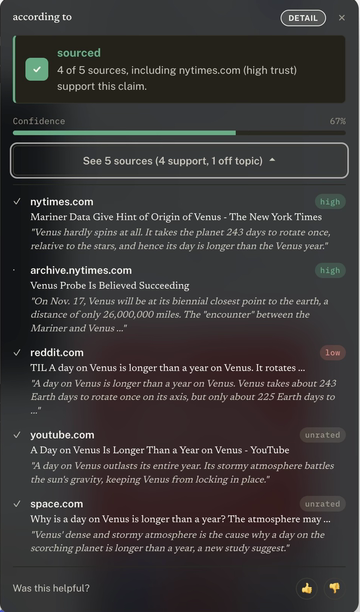
    Each source is weighed by your own trust rating and by whether its text actually supports or refutes the claim, combined into one plain-language result — with every source listed right there, and a confidence bar you can read at a glance.
The according to result card: a green “sourced” verdict reading “4 of 5 sources, including nytimes.com (high trust) support this claim”, a 67% confidence bar, and five sources listed underneath — nytimes.com and archive.nytimes.com marked high trust, reddit.com low, youtube.com and space.com unrated — each with the quoted sentence it was judged on.
A real check, not a mockup: the verdict, how much of it the sources actually carry, and every source with your own trust rating and the sentence it was judged on.
03 · THE PRINCIPLES

Built to be inspected, not just trusted

Those are claims about the design, so they are measured rather than asserted: 223 hand-labelled cases, re-run whenever a prompt changes. See how often it gets this wrong.

Add to Chrome Next: what it costs
The model never answers from memory
Every result is grounded in retrieved evidence you can see — the model is only ever asked to judge whether a specific snippet supports or refutes a claim, never to recall the answer itself. It also judges each source only on that source's own words, never borrowing another one's wording as evidence.
You decide who to trust
Rate domains on your own scale — a source's weight in the result comes from your trust list, not a fixed opinion baked into the extension. Rating a publisher covers its subdomains too, so rating nytimes.com also covers well.blogs.nytimes.com — but never a lookalike domain that merely contains the name.
Contradictions get a second look
Calling a source contradictory is the easiest mistake to make and the most damaging one, so it isn't taken on the first pass. Anything flagged as contradicting a claim is re-checked with a second, narrower question — could the claim and this source both be true? — before it's allowed to count.
Never "true" or "false"
sourced— traced to a primary document
no source found— claim stands alone
contradicted— primary sources disagree
not assessable— opinion or anecdote, not a checkable claim
04 · PRICING

Pricing

Start free, no card needed. You can subscribe here or from the extension's Account tab — it's the same account either way.

Questions first?
START HERE
Free
€0
FOREVER
Every feature of the extension — the trust list, the source lists, the dashboard. Just fewer checks.
25 FACT-CHECKS / MONTH
Regular
€7.99
PER MONTH, VAT INCLUDED
or €64.99 a year
Checks run on our AI key — nothing to set up, nothing else to pay for.
250 FACT-CHECKS / MONTH
Bring your own key
€3.99
PER MONTH, VAT INCLUDED
or €34.99 a year
About half the price, because you supply your own Anthropic API key and the model usage bills to you, not to us.
250 FACT-CHECKS / MONTH

One plan at a time — Regular and bring-your-own-key are alternatives, not add-ons. Switch or cancel whenever you like from Stripe's own billing portal; we never see your card details. Already have an account? Sign in to subscribe here.

GETTING STARTED TAKES A MINUTE
  1. 1
    Add it to ChromeFree, from the Chrome Web Store. Works in any Chromium browser.
  2. 2
    Create your free accountHere or in the extension. It holds your trust list, so your ratings are there on every page.
  3. 3
    Highlight any sentenceRight-click, choose "Fact-check selection", and read the sources. 25 checks a month are free.
05 · QUESTIONS

Questions people ask first

The ones worth answering before you install anything.

Back to pricing
Does it tell me whether a claim is true?

No, and it never will. It reports attribution: which sources say something about the claim, what each of them actually says, and how much weight you have given them. There are four outcomes — sourced, no source found, contradicted and not assessable — and none of them is "true" or "false". The judgement stays yours.

How is this different from searching it myself?

For one sentence, it isn't — searching is exactly what it does. The difference is that it keeps the work: it runs the search, holds on to every result, records which sentence in each result it judged the claim against, ranks them by your own source list rather than by whatever ranked first, and hands you that as something you can show an editor. For the fortieth claim in a document, the tab-juggling is the work.

Can the AI invent a source?

It cannot, because it never supplies the sources. They come from a live web search, and the model only ever sees the results that search returned. It is never asked whether the claim is true, only whether one specific retrieved snippet supports one specific sentence. What it can still do is read a snippet wrong, which is why every source is shown next to the exact text it was judged on.

How accurate is it?

61% of individual source judgements match a human label, and 75% of claims end up with the verdict a human would give. The figure held to the highest bar is how often it is right when it says a source contradicts a claim: 87%, against a 95% target that has not been met. All of it, per label and with the method, is on the accuracy page, including the parts that do not flatter it.

Who decides which sources count as credible?

You do. Nothing ships with an opinion about who is reliable — source weight comes from a trust list you build yourself, and a rating carries down to a domain's subdomains but never to a lookalike domain. It means the extension is least useful on the day you install it, before you have rated anything, which is a real cost and a deliberate one.

Is it useful for writing rather than reporting?

Yes, for the same reason. The task it shortens is "somebody stated this as fact, and I need to know who said it first" — which is as common in a commissioned feature, a book chapter or a literature review as it is in an investigation. It is built for journalists and fact-checkers, so the language is theirs, but nothing in it is specific to a newsroom.

Which browsers does it work in?

Chrome, Edge, Brave, Opera, Vivaldi and Arc — anything built on Chromium. The store button says Chrome because the Chrome Web Store is where it is published; installing from there works in all of them. Firefox and Safari are real ports rather than a switch, and are not done.

Does it work on PDFs or behind a paywall?

It reads titles and search snippets, not full articles. A claim whose only source is a PDF nobody has indexed, or an article behind a paywall a search engine cannot see, comes back as no source found. That is honest, and it is not much help — it is the clearest limit the tool has.

What happens to the text I select?

The claim you confirm is sent to the backend so it can be searched, and the search query and the model's output are stored so the quality of both can be measured over time. The raw text you highlighted is deliberately never logged. Full detail, including every third party involved, is in the privacy policy.

What does it cost?

25 checks a month are free, with no card and every feature included. Beyond that it is €7.99 a month, or €3.99 if you bring your own API key and cover the model calls yourself. Both are capped at 250 checks a month. Prices include VAT.

READY WHEN YOU ARE

Check the next claim you read.

25 fact-checks a month, free, with no card needed. Works in Chrome, Edge, Brave, Opera, Vivaldi and Arc.